China’s vape device industry includes manufacturers with very different strengths, production models, and quality systems. Some focus on compact pod devices, while others build high-volume products for established brands. This variation makes supplier research essential.
The real question is how to choose a reliable vape device manufacturer. Buyers should examine factory experience, product development capabilities, material controls, and documented testing procedures. A dependable manufacturer should explain its quality process clearly, from incoming component inspection to final device testing. Ask for sample reports, certifications, audit records, and evidence of consistent production. Do not rely only on polished websites or attractive samples.
Details often reveal more than promises. Look at battery protection, charging performance, leak resistance, packaging accuracy, and batch traceability. Request samples from different production batches when possible. Compare their airflow, finish, labeling, and performance under normal use. Small differences may expose weak process control. Not every factory failure is obvious.
This guide reviews ten leading Chinese vape device makers through practical business criteria, including manufacturing capacity, research expertise, customization support, communication, and compliance awareness. The list is not a permanent ranking. Market conditions change, and a manufacturer with strong hardware may still lack dependable after-sales support. Buyers should verify current information independently and confirm that every product meets the laws and safety requirements of its destination market. Experience matters. So does careful doubt. Reliable partnerships are built through evidence, transparent communication, and repeated performance, not impressive claims alone.
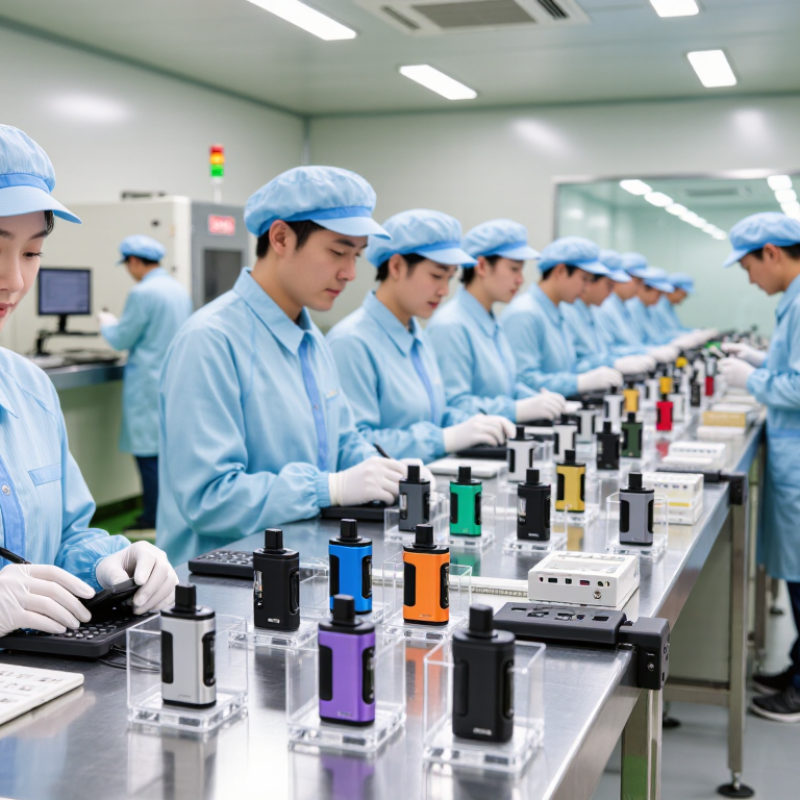
China Top 10 Vape Device Makers: How to Choose Reliable Ones?
China’s vape device manufacturing landscape is concentrated around Shenzhen and nearby technology clusters. The 2023 China Electronic Cigarette Industry Export Blue Book estimated that Chinese manufacturers supplied more than 90% of global vaping hardware exports. This scale comes from dense supplier networks, automated assembly lines, mold workshops, and experienced electronics engineers.
The structure is highly specialized. One factory may produce batteries, while another handles chip programming, metal stamping, or final assembly. Buyers should examine the entire supply chain, not only the factory showroom. ISO 9001 certification, incoming-material records, battery safety testing, and batch-level traceability are practical signals of manufacturing discipline. UL, CE, RoHS, and UN 38.3 documentation may also be relevant, depending on the destination market.
Market pressure is changing the industry. A 2024 Grand View Research report projected continued growth in the global vaping device market, but growth does not guarantee dependable production. Some suppliers still rely on manual inspection or unclear subcontracting. That is a weakness worth questioning. Request factory audit reports, sample test results, defect-rate records, and corrective-action evidence. Ask how firmware changes are controlled. Ask who owns the molds.
A reliable manufacturer should explain failures plainly. Silence is not quality.
| No. | Industry Dimension | Verified Landscape Information | What to Check When Selecting a Reliable Manufacturer |
|---|---|---|---|
| 1 | Manufacturing Concentration | China’s vape hardware supply chain is concentrated mainly in the Pearl River Delta, especially Shenzhen and nearby manufacturing cities in Guangdong. The region combines electronics assembly, precision machining, molds, packaging, batteries, and logistics. | Confirm the factory address, production ownership, equipment list, and whether critical processes are performed in-house or outsourced without documented control. |
| 2 | Main Product Categories | The industry commonly produces disposable devices, refillable pod systems, open-system vaporizers, regulated box-style devices, cartridges, heating components, and device accessories. | Match the supplier’s established product category with the required device architecture, target market, battery specification, and expected annual volume. |
| 3 | OEM and ODM Structure | Many Chinese manufacturers operate through a mixture of OEM production, private-label manufacturing, and ODM development. Capabilities may include industrial design, electronic engineering, firmware integration, tooling, assembly, and packaging. | Request a clear responsibility matrix covering design ownership, tooling ownership, firmware access, change control, minimum order quantity, and after-sales support. |
| 4 | Compliance Framework in China | China brought e-cigarette production, operation, and import/export activities under tobacco monopoly administration through legal and regulatory changes. The national standard GB 41700-2022 for electronic cigarettes took effect on October 1, 2022. | Verify applicable tobacco, product-safety, labeling, testing, and customs requirements for both the manufacturing location and the destination market. |
| 5 | Quality Management | Reliable device production normally requires documented incoming inspection, process inspection, final inspection, traceability, nonconformance handling, and controlled engineering changes. Quality maturity varies significantly between factories. | Review the quality manual, inspection standards, sampling plans, corrective-action records, production traceability, and recent third-party audit results. |
| 6 | Battery and Electrical Safety | Vape devices commonly use lithium-ion or lithium-polymer cells. Key safety concerns include overcharge, over-discharge, short circuit, overheating, cell damage, charging faults, and inappropriate protection-circuit design. | Require battery specifications, protection-circuit test records, charging tests, abnormal-use tests, transport documentation, and evidence of controlled cell sourcing. |
| 7 | Core Electronics and Firmware | Device reliability depends on the controller, sensors, power-management circuit, charging interface, display or indicator system, and firmware logic. Component substitution can affect safety, performance, and regulatory testing. | Ask for a controlled bill of materials, approved component list, firmware version records, functional test fixtures, and written approval procedures for substitutions. |
| 8 | Manufacturing Capacity | Capacity is determined by assembly-line count, automation level, testing stations, shift arrangements, component availability, and production scheduling. Advertised capacity may not equal available capacity during peak seasons. | Validate monthly output using production records, line-balancing data, sample lead times, peak-season planning, and a written capacity reservation agreement. |
| 9 | Export and Market Adaptability | Export requirements differ by jurisdiction. Common buyer requirements may involve electrical safety, electromagnetic compatibility, battery transport, packaging, recycling information, age restrictions, nicotine rules, and market-specific product notification. | Select a supplier with documented experience in the destination market and require a compliance gap analysis before tooling or mass production begins. |
| 10 | Supplier Reliability Indicators | The strongest indicators are transparent factory information, stable engineering and quality teams, consistent sample-to-mass-production performance, traceable materials, realistic lead times, and responsive corrective-action management. | Use a weighted supplier scorecard covering ComplianceQualityCapacityTechnical SupportTraceabilityCommercial Stability. |
Request quality-system documents, recent audit records, batch inspections, and clear production responsibilities. A readable batch code matters.
Each batch should have a code, inspection record, retained sample, and identified component suppliers. Traceability exposes weak controls.
Ask for battery safety, electrical performance, leakage resistance, material compatibility, and transport-testing reports. Use accredited laboratories when possible.
No. It supports process control, but it does not prove every factory procedure works consistently. Certificates are not magic.
Watch battery handling, sealing, charging tests, rejected-unit storage, and packaging checks. Look beyond the showroom.
A small pilot run reveals failure rates, output consistency, packaging accuracy, and response speed before a larger contract. Samples can mislead.
Ask engineers to explain airflow tolerance, leakage prevention, charging protection, and material compatibility in plain language. Unclear answers concern me.
Confirm labeling, packaging, recycling, safety files, age-controlled sales, and recall procedures for every destination market. Rules differ widely.
Review corrective-action records, complaint history, replacement procedures, and response times after delivery. Past defects are informative.
Yes. No audit is perfect, and polished facilities can hide weak controls. I might still miss something.
China has developed a diverse vape device manufacturing landscape, ranging from specialized component producers to fully integrated factories offering design, engineering, assembly, and packaging services. This article explains how to choose a reliable vape device manufacturer by examining production capacity, technical expertise, quality management systems, material traceability, testing procedures, and communication efficiency. It also presents a practical approach to comparing leading Chinese manufacturers based on customization capabilities, minimum order requirements, delivery performance, after-sales support, and long-term cooperation potential.
Before making a decision, buyers should verify factory information, review production facilities, assess sample quality, and confirm that products meet applicable safety, environmental, and market requirements. Clear documentation, consistent quality control, transparent business practices, and responsible product development are essential indicators of a dependable partner. By combining factory audits, product testing, regulatory checks, and structured supplier comparisons, businesses can reduce sourcing risks and select a manufacturing partner that supports stable quality, reliable delivery, and sustainable cooperation.

 Luvn Vape